
Climate Neutrality Forum
Accelerating Climate Action Now
About the Climate Neutrality Forum
The Climate Neutrality Forum is a platform for understanding and achieving climate neutrality. It was first organised in 2021 by Oxford Net Zero, JPI Climate, and the ClimateWorks Foundation.
As a valuable forum for dialogue between science, policy and practitioners, the Climate Neutrality Forum will continue as a biennial event with editions in 2024 and 2026. These editions will inform actions in this critical decade and result in a report detailing the latest information on decarbonisation, as well as inform future contributions to the Global Stocktake.
Building on the 2024 edition, The Equinox Climate Neutrality Forum 2026 returns to Brussels on May 28-29 bringing together leading voices from science, policy, and innovation to take stock and accelerate progress.
From emissions reductions and carbon dioxide removal to the political economy of transformation, the Forum will sharpen priorities and identify the most effective pathways forward.
Assessing progress towards climate neutrality a decade after the Paris Agreement, the outcomes of the forum will build a comprehensive CNF 2026 Report, providing an up-to-date synthesis of the latest science, policies, and implementation gaps.
What topics can the audience expect at the CNF2026 edition?
- Understanding Progress: Climate Science & Indicators including Climate trends & carbon budgets
- Emissions Reduction & Energy Transition: Sectoral pathways and Energy systems transformation
- Scaling Solutions: Carbon Dioxide Removal (CDR), governance frameworks and insights on what works
- Enabling Transformation: Political Economy & Finance; Financing a (just) transition
The forum will feature cross-cutting dialogues in Science–policy–practice.
Registrations are open here: Climate Neutrality Forum 2026: Registration Form.
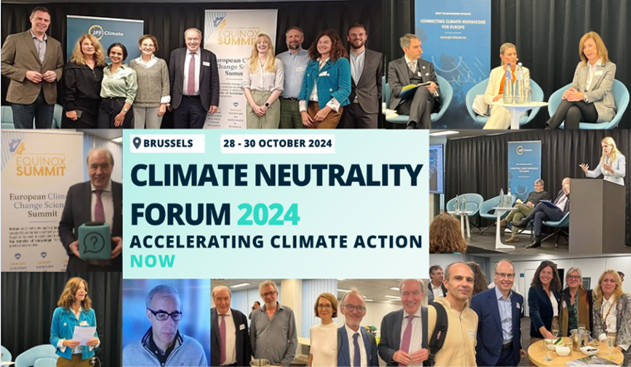
The Climate Neutrality Forum 2024 took place on 28 to 30 October 2024 in Brussels. The Climate Neutrality Forum is a biennial place for discussion on what is (not) working in the transition, what priority actions should be taken, and which interventions are most effective.
Read the report of our 2024 Climate Neutrality Forum
In 2024, the Climate Neutrality Forum aimed to provide an update of the best-available science, identify effective policies for emissions reduction and removals, and elucidate areas for further policy development so that progress towards climate neutrality may be accelerated. All of this is captured in the accompanying report on the Forum, which will be available soon!
Rewatch the 2024 Forum on Youtube
We explored the progress towards emissions reductions and the energy transition, and the role of R&I programmes in supporting this progress. The current state of knowledge on carbon dioxide removal (CDR) was examined as well, discussing the realistic potential of land and marine CDR technologies as well as avenues for their deployment and upscaling. Finally, we turned to the political economy required for enabling transformative change and accelerating progress.
You can always revisit the programme or learn more about the speakers from the Climate Neutrality Forum 2024.
The first Climate Neutrality Forum (CNF2021) took place September to November 2021. It was designed to explore key features of and challenges in achieving climate neutrality.
The CNF2021 was informed by the work of the Intergovernmental Panel on Climate Change (IPCC) during its 6th Assessment Cycle, in particular the IPCC Special Report on Warming of 1.5 C (SR1.5) and the IPCC Working Group I report on Scientific Understanding of Climate Change which was published in August 2021.
CNF2021 resulted in a summary report on Sensitive Intervention Points for achieving Climate Neutrality: Solutions which transform a system or take advantage of an amplification dynamics in part of the system that is at or near a tipping point or state of ‘criticality’ (Hepburn et al., 2020)
Read the report of the 2021 Climate Neutrality Forum
What are Sensitive Intervention Points?
The focus of the CNF2021 was on key challenge topics with the objective of identifying Sensitive Intervention Points within these topics:
- Equity and Justice
- Rapid Emissions Reductions
- Final 20% Hard-to-Decarbonize Sectors
- Nature Land use and Agriculture
- Greenhouse Gas Removal
- Finance and Policy
Sensitive Intervention Points are strategic solutions designed to enable transformative change to rapidly reduce GHG emissions or increase carbon sequestration. Sensitive intervention points are strategic actions that can lead to disproportionate effects, by taking advantage of positive feedback loops or amplification dynamics in part of the system that is at or near a state of ‘criticality’ (Farmer et al., 2019).
The summary report is focused on the outputs from these considerations at the CNF2021 and in a subsequent webinar series. The importance of the framing issues around physical sciences, formulation of climate ambition and scenarios were largely in the background. These were highlighted during the high-level opening and closing sessions and are included in the summary report as context for the CNF2021.

Stay up to date with all research and results of JPI Climate.
Subscribe for our newsletter to stay up to date with the latest information.